Physical Address
304 North Cardinal St.
Dorchester Center, MA 02124
Physical Address
304 North Cardinal St.
Dorchester Center, MA 02124

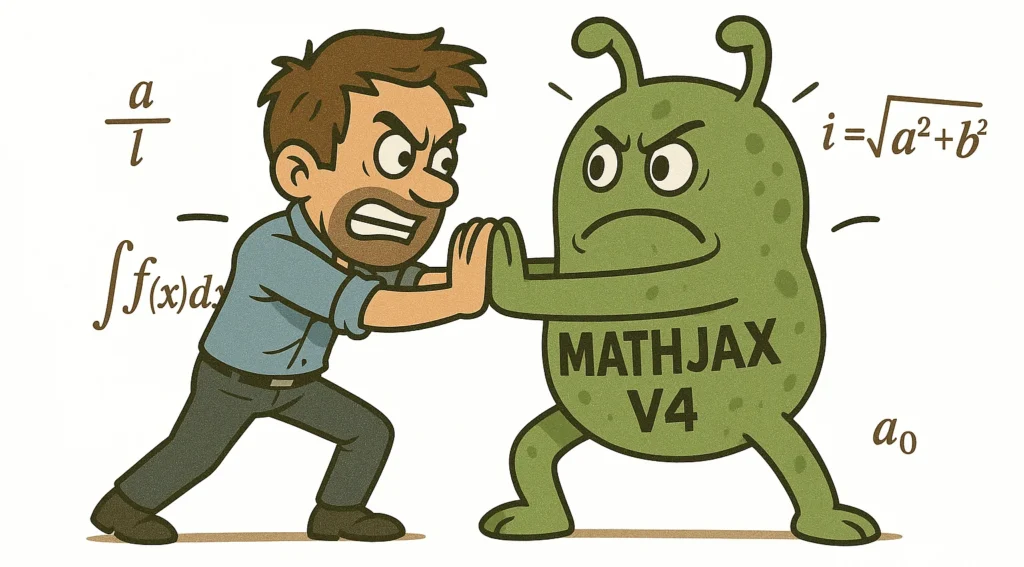
This week, I descended into the underworld of MathJax, armed with nothing but Next.js, TypeScript, and misplaced optimism. Spoiler: optimism didn’t last long. MathJax v4 threw over 55 unique errors at me — some hilarious, some infuriating, and some so weird I questioned whether my codebase was haunted.
By Sunday, though, the monster was tamed. The tutorial is nearly finished, and I’m still polishing it up before it goes live. In the meantime, here’s the saga.
Started by exploring MathJax v3 integration, only to realize I was playing with the wrong toy.
Deleted the entire project directory. If you’ve never felt the catharsis of rm -rf on a stubborn codebase, I highly recommend it.
Switched to v4, hit rendering issues immediately, and found out the only way forward was to use React’s dangerouslySetInnerHTML. Not exactly confidence-inspiring.
Built <InlineMath> and <DisplayMath> components. Simple, clean, and slightly functional.
Tried to implement dynamic font switching. Euler fonts rebelled, CDN links broke, recursion errors happened. Eventually gave up and settled for stability over style.
LaTeX and JSX don’t get along. Backslashes went missing like socks in the dryer. Solution: template literals with backticks. Clean, effective, slightly cursed.
Rewrote the README from scratch — clearer, cleaner, and with fewer opportunities for future-me to swear. Added a configuration system, only to rip it out later when it caused more trouble than it solved.
Finally cracked equation labeling and cross-references. Solved the “labels floating in another time zone” problem by constraining <DisplayMath> to 50% width. Added advanced examples: matrices, vectors, aligned equations, even colored math. Documentation now felt like a textbook with jokes.
Expanded the README to 1100+ lines, filled with step-by-step instructions, Maxwell’s equations for flair, and troubleshooting tips that read like a survival guide.
MathJax is not defined became my new ringtone.Total: 55+ errors, countless retries, and one developer whose will to live briefly resembled an unclosed bracket.
At some point between the tenth TypeScript error and the fourth recursive font failure, I realized debugging isn’t about solving problems. It’s about developing enough stubbornness to refuse defeat. Debugging is the art of becoming unreasonably confident that the computer is wrong — even though deep down you know it’s right.
When the README crossed the 1,100 line mark, I started wondering if I had accidentally written a short novel. It has character arcs (the <InlineMath> component learns to behave), conflict (JSX vs. LaTeX), and even foreshadowing (font issues hinted at earlier, before their dramatic return). At this point, publishing the tutorial feels less like releasing documentation and more like dropping the next entry in a serialized drama.
Once the MathJax tutorial is polished and published, the next beast is already lurking. Maybe it’ll be routing quirks in Next.js. Maybe React’s suspense API will ambush me. Maybe TypeScript will evolve sentience and start arguing about my code in real time. Whatever it is, the tradition of wrestling new errors into submission — and writing about them with gallows humor — is officially the core loop of this project.
Next week’s mission is simple: finish polishing and publish the MathJax v4 tutorial. After that, I’ll find a new web-dev beast to wrestle — probably lurking in the React/Next.js jungle, disguised as an “improvement.”
This story was generated with the help of generative AI. You can view the original chat where it was written here